
Ocean-access homes for sale, Fort Lauderdale
A dock is a place to tie up a boat. Ocean access is the freedom to actually go somewhere with it. The two get sold as the same thing constantly, and the gap between them, plus the gap between 'ocean access' and 'no fixed bridges,' is exactly where boat buyers lose the most money.
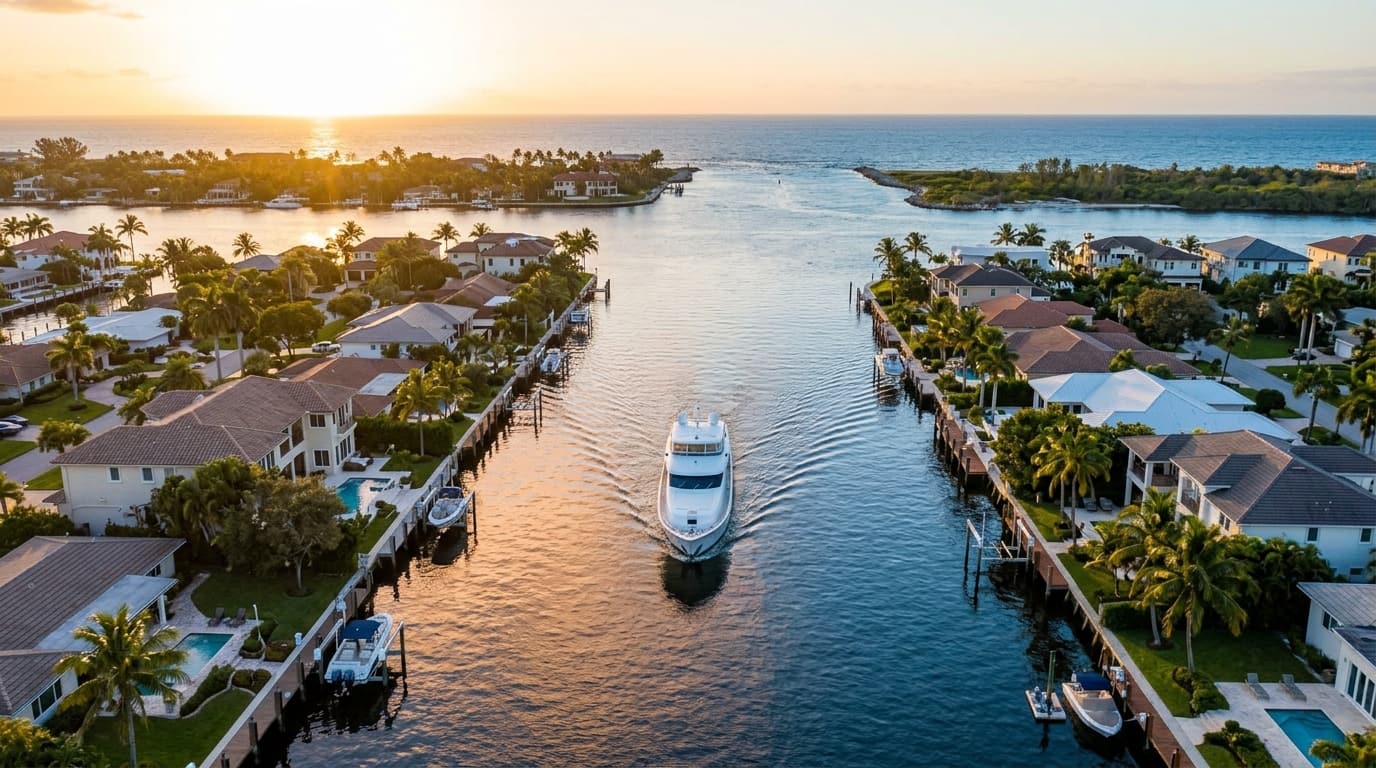
"Ocean access" in Fort Lauderdale means a boat can navigate from the home's dock out to the Atlantic. What it does not automatically mean is "no fixed bridges", many ocean-access routes still cross drawbridges (bascule bridges) that open on a schedule or on signal, like the 17th Street Causeway and Las Olas bridges. That distinction is small in a listing and enormous on the water.
"No fixed bridges" is the premium designation: the whole run to the inlet crosses only opening bridges, or none, so there is no permanent overhead height limit. That's what a sailboat's mast, a sportfish tower, and a flybridge all need. Most listings won't use the phrase precisely, and most agents won't verify it. I do, because a fixed bridge is concrete, and it decides your boat.
The facts that actually decide access
For a given boat and a given dock, a handful of facts settle whether it can really reach the ocean:
- Air draft, not just depth, on a fixed-bridge route the limit is vertical clearance. The federal standard fixed-bridge clearance on the ICW is about 65 ft, so a mast or tower taller than roughly 64 ft can't pass a 65-ft span regardless of tide.
- Lower bridges exist, some Broward crossings are fixed bridges well under 65 ft, which cut off larger vessels entirely; that's why you map every bridge between a specific dock and the inlet, not a neighborhood label.
- Tide moves clearance, clearance under a fixed bridge shrinks at high tide and grows at low; with a 2 to 3 ft tidal range, a foot can decide whether a boat clears, so marginal passages are timed to low tide.
- Depth is a separate test, a home can be no-fixed-bridge yet sit on a shallow canal, or be deep yet sit behind a low bridge; both depth at mean low water and the bridge route must check out.
- Distance to the inlet, homes a few minutes' idle from Port Everglades with no bridges are the most liquid and command the strongest premiums; each added bridge or mile lowers the practical boating value.
Port Everglades is one of the deepest ports in Florida, with main channels dredged to roughly 42+ ft, which is why deep-draft yachts base near it, and why a straight, bridge-free run to it is prime no-fixed-bridge territory.
The honest catch: the label isn't the route
Here's what costs buyers their boat. "Ocean access" and "no fixed bridges" get used as if they mean the same thing. They don't, and no neighborhood label guarantees either one for a specific address. A genuine big-boat home and one that only photographs like one can sit a few blocks apart on the same canal, separated by a single low bridge you'd never notice from the driveway.
No-fixed-bridge inventory is concentrated in the eastern isles and canal neighborhoods closest to the inlet, Las Olas Isles, Rio Vista, Harbor Beach, Seven Isles, a function of geography and bridge layout. But "close to the inlet" is a starting point, not a guarantee. I treat bridge-by-bridge air draft and canal depth as first-class facts and map the actual route before you write an offer.
What I verify before you offer
For every ocean-access home you're serious about, I confirm four things before we talk price:
- Every bridge to the inlet, each span between the dock and open water, whether it's fixed or opens, and its clearance if fixed.
- Air draft vs. your boat, the tallest vessel that can actually make the run, at the tide it has to make it on.
- Depth at mean low water, sounded at the seawall, against your boat's draft, not read off a listing photo.
- Distance and conditions, real minutes to Port Everglades, plus inlet current and traffic, so the ocean access is a known quantity, with a real flood-zone and insurance picture inside your inspection period.
New to this? Read fixed bridges explained and ocean access vs. Intracoastal first.
Where to find these homes
Ocean-access and no-fixed-bridge inventory clusters near the two inlets. The strongest places to look:
- Fort Lauderdale, Las Olas Isles, Rio Vista, Harbor Beach, and Seven Isles hold the deepest no-fixed-bridge inventory near Port Everglades.
- Lighthouse Point, deep-water finger canals with fast, no-fixed-bridge access to the Hillsboro Inlet.
- Pompano Beach, ocean-access canals at a lower entry point, near the same northern inlet.
- Deerfield Beach, The Cove, sharing the Hillsboro Inlet run.
- Homes with a boat dock, start from the dock and match the route to your boat.
Tell me your boat's length, draft, and air draft, and I'll shortlist the neighborhoods where the route to the ocean actually clears it.
Selling an ocean-access home
If your home has a true no-fixed-bridge run to the inlet, that's the most valuable thing about it, and the marketing has to prove it, bridge by bridge, not just claim it. See how I market luxury waterfront homes, with media and documentation that show a boating buyer exactly what their vessel can do from your dock, in English o en español.
Ocean-access questions
What does "ocean access" mean for a Fort Lauderdale home?
It means a boat can navigate from the home's dock out to the Atlantic, but it does not automatically mean 'no fixed bridges.' Many ocean-access routes still cross drawbridges (bascule bridges) that open on a schedule or on signal. Ocean access is real and valuable, but the phrase alone doesn't tell you the tallest boat that can make the run. I map the actual route before you treat it as unlimited.
What does "no fixed bridges" mean, and why does it cost more?
It's the premium designation: the entire run from the dock to the inlet crosses only opening bridges, or none at all, so there is no permanent overhead height limit. That's what large sportfish yachts and tall-masted sailboats require, because a fixed bridge is concrete, you can renovate a kitchen, you cannot raise a bridge. A no-fixed-bridge route is why two docks that look identical can be worth very different money.
What's the difference between ocean access and no fixed bridges?
They get used interchangeably in listings, and they are not the same thing. On a fixed-bridge route the limiting factor is air draft, vertical clearance, not water depth. The federal standard fixed-bridge clearance on the ICW is about 65 ft, so a sailboat with a mast taller than roughly 64 ft, or a yacht with tall towers and antennas, cannot pass a 65-ft span regardless of tide. Some Broward crossings are lower fixed bridges well under 65 ft, cutting off larger vessels entirely. For every home, I map what the tallest and deepest boat that can actually reach the ocean is.
Is a home with a dock the same as ocean access?
Not necessarily. A dock only means you can tie up a boat. Ocean access means that boat can actually travel to the open sea, and canal depth is separate from bridge clearance. A home can be "no fixed bridges" yet sit on a shallow canal, or have deep water but sit behind a low fixed bridge; both the depth at mean low water and the bridge route must check out for a given boat. I confirm the whole path before you buy.
Which inlet do these homes run out to?
Two inlets serve area boaters. Port Everglades is the main deep-water, federally maintained, jettied inlet with no overhead obstruction, one of the deepest ports in Florida, which is why deep-draft yachts base near it and a straight, bridge-free run to it is prime 'no fixed bridge' territory. To the north, the Hillsboro Inlet is shallower and prone to shoaling, better suited to smaller vessels. Time and distance to the inlet is a real value driver, and I clock it honestly for each home.
Want a home your boat can actually leave from?
Tell me the boat, length, draft, and air draft, and I'll find the ocean-access homes that fit: no fixed bridges where you need them, verified depth, and an honest run to Port Everglades.