
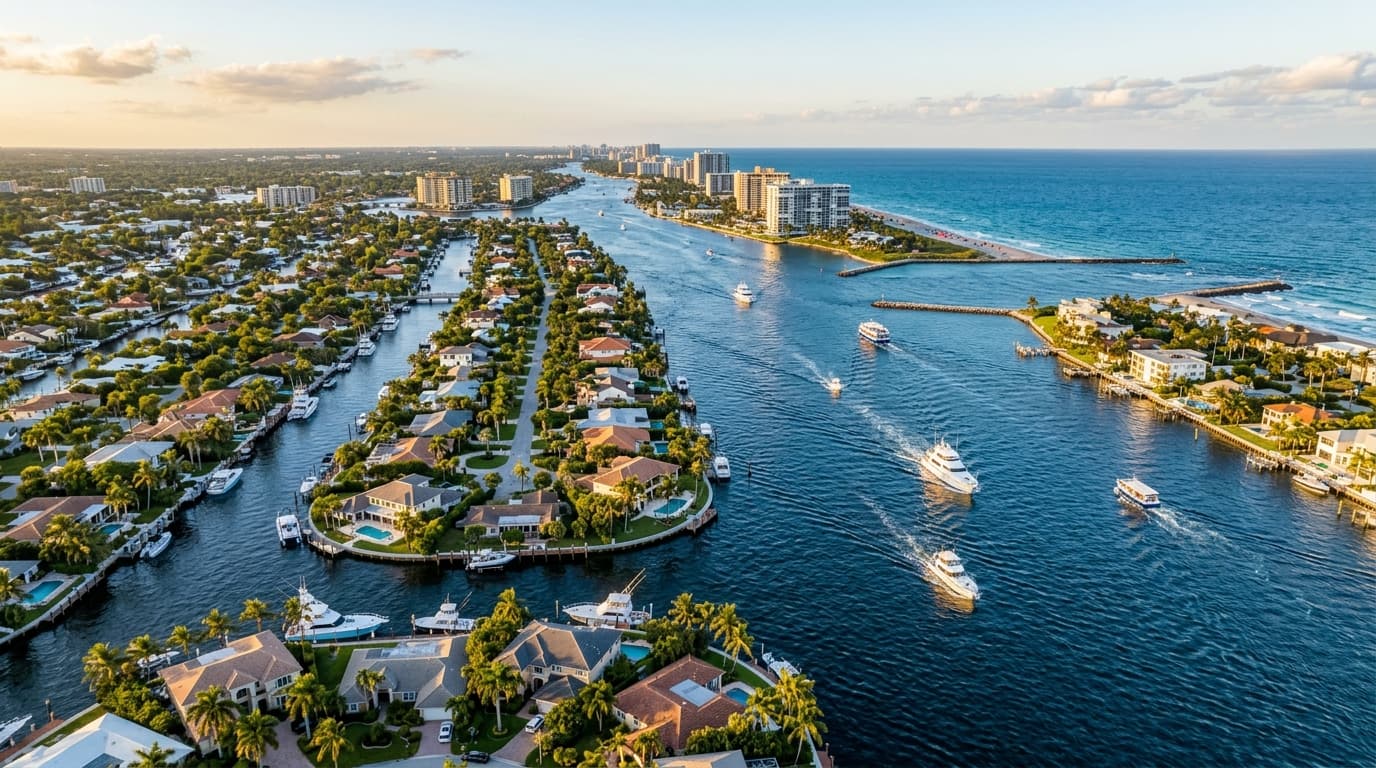
Every waterfront buyer in Fort Lauderdale eventually asks the same question, and most ask it too late: can my boat actually get to the ocean from here? The listing says “waterfront.” The photos show a gorgeous canal. None of that answers the question. Let’s fix that.
What “Intracoastal” actually means
The Intracoastal Waterway is the protected channel that runs parallel to the coast. A home on the Intracoastal has wide-open water out front, big views, and boat traffic to watch. That’s the appeal, and it’s a real one.
But Intracoastal frontage describes where the home sits, not where your boat can go. Plenty of stunning Intracoastal and canal homes have a fixed bridge sitting between the dock and the nearest inlet. For a center console, that may not matter. For a sport-fisher with a tower or a sailboat with a mast, it’s the whole ballgame.
What “ocean access” actually means
Ocean access means there’s a navigable path from your dock, through the canal or Intracoastal, out an inlet, to the open ocean. In Fort Lauderdale that inlet is usually Port Everglades. The quality of that access comes down to three variables:
- Bridges. A fixed bridge has a set clearance your boat cannot exceed. A drawbridge opens, but on a schedule. “No fixed bridges” is the gold standard because nothing caps your air draft.
- Depth. Canals silt in. A dock that floats a boat at high tide can trap it at low tide. You confirm depth at low tide, not from a listing photo.
- Distance. Ten minutes to the inlet and forty minutes to the inlet are different lifestyles. Neither is wrong. You just want to choose it on purpose.
The mistake I see most often
A buyer falls for the house, the dock, the view. They assume “waterfront” means their boat is set. Then, weeks after closing, they learn the 42nd Street bridge, or a private community’s fixed span, means their dream boat will never fit under it. The house was never the problem. Nobody mapped the water.
That’s the entire reason I walk the dock and pull the route before you ever write an offer. On a waterfront home, the water is half the asset. You should buy it with the same eyes you’d use on the roof.
Want to see how the top neighborhoods stack up on access, dockage, and price? Start with my guide to the best waterfront neighborhoods in Fort Lauderdale, then browse ocean-access homes with no fixed bridges.