
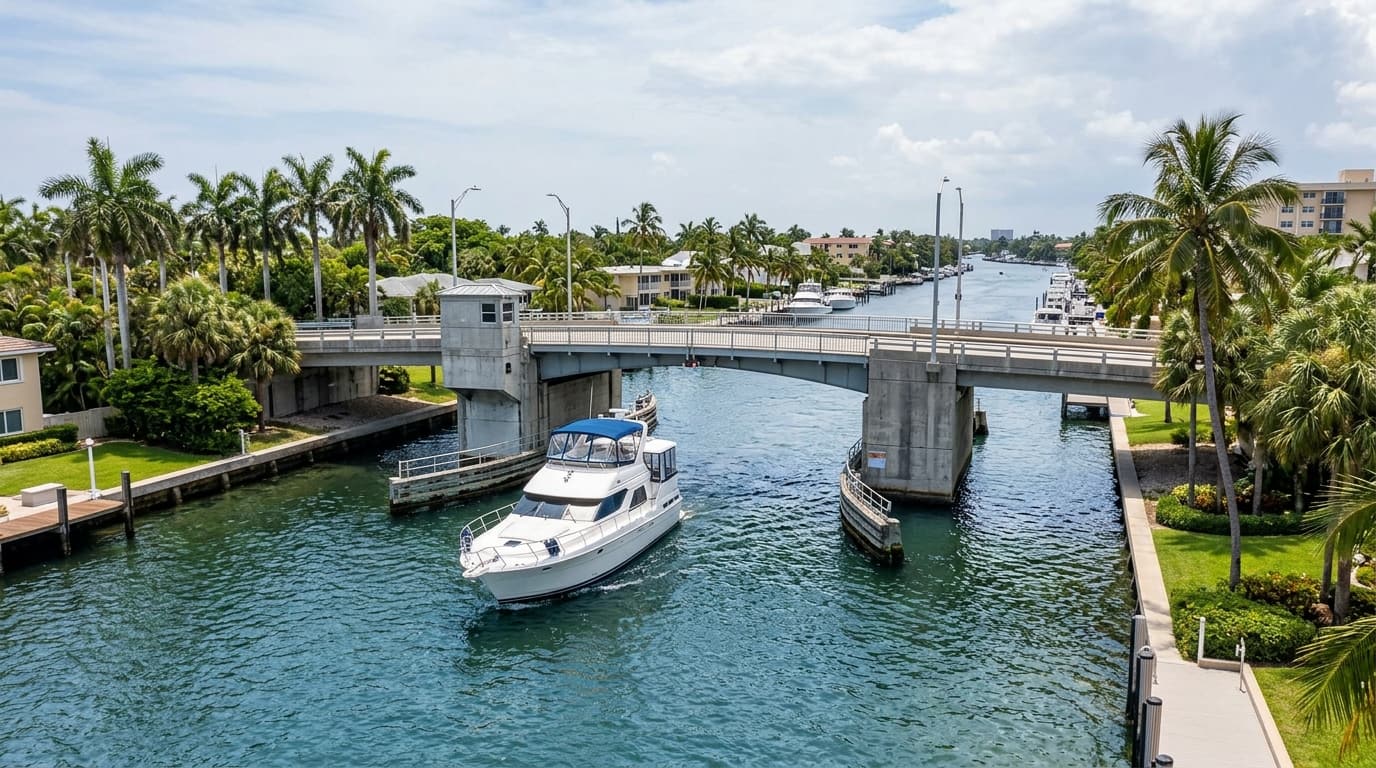
If ocean access is the question, fixed bridges are the reason so many “waterfront” homes quietly fail the test. Here’s how to read them like a boater instead of a brochure.
What Is a Fixed Bridge?
A fixed bridge never opens. Its posted clearance, measured at mean high water, sets a hard ceiling on your boat’s tallest point.
Clearance is the distance from the water to the underside of the span. Compare that number to your boat’s height, called air draft. If your air draft is less than the posted clearance, with a comfortable margin, you fit. If it isn’t, there’s no negotiating with concrete.
What Is Air Draft?
Air draft is your boat’s height above the waterline to its tallest fixed point: hardtop, tower, radar arch, or an antenna that doesn’t fold down.
Anything solid and permanent counts, even gear that never comes down. Measure the actual boat, not the brochure spec, since owners often add electronics or a hardtop after they buy.
How Much Clearance Do I Need Under a Fixed Bridge?
Add your boat’s full air draft to a safety margin, then check it against the posted clearance at high tide, not low.
Most boaters want at least a couple of feet of cushion beyond the number on paper, for waves, wake, and instrument error. The only reliable answer for your boat and a specific bridge is to measure the air draft yourself and compare it to the posted clearance at high tide.
Tide Works Against You Here
This trips up newcomers constantly. Bridge clearance is quoted at mean high water, so the posted number sits close to the least clearance you’ll ever get. At low tide the water drops and you gain a little room. At high tide you have the least. Plan around high water, not the friendly low-tide number, and keep a cushion for waves and wake.
Why Do Fixed Bridges Affect a Home’s Price So Much?
A fixed bridge permanently caps the size of boat that can reach the ocean from that dock, and buyers pay for that difference.
Say two homes sit a block apart on similar canals. One has a clear run to Port Everglades and can serve a sport-fisher with a tower or a mid-size sailboat. The other sits behind a 15-foot fixed bridge and is capped at low-profile boats. To a buyer who doesn’t boat, the homes look identical. To a buyer who does, one is worth far more, which is exactly why sellers of true no-fixed-bridge homes market that phrase so hard, and why buyers should verify it rather than take it on faith.
How I Check Bridge Clearances for You
I map every bridge between the dock and the inlet, note its posted clearance, and match it against the boat you own.
If you’re shopping the boat and the house at the same time, I sequence the search so one doesn’t box in the other. Ready to see homes chosen for their dockage and access? Browse homes with boat docks and read the companion guide on ocean access vs. Intracoastal.