
Homes with boat docks for sale, Fort Lauderdale
The dock is where the fantasy lives, coffee on the dock, the boat idling behind the house. But a dock is a system: depth at low tide, lift capacity, seawall, permits, and the water route in front of it. In the Venice of America, I help you buy the whole system, not just the photo.
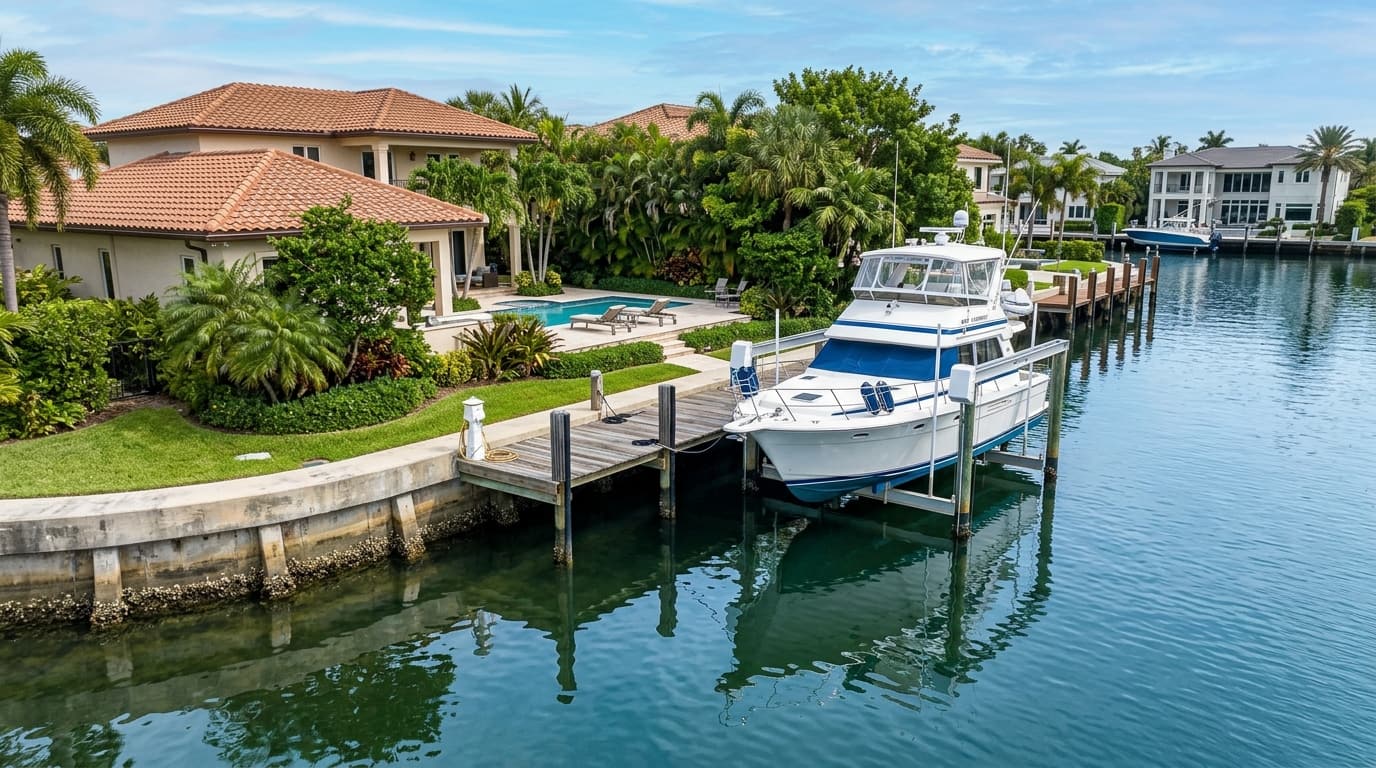
A home with a boat dock is the reason most people move to the water here, and Fort Lauderdale delivers it better than almost anywhere. The city is nicknamed the "Venice of America" for a reason: Waterway Guide counts nearly 300 miles of mostly navigable inland waterways and canals in the area, which is why a private dock is a defining feature of the market rather than a rare extra.
But a dock is not a single fact, it is a stack of them. Length, depth at mean low water, lift capacity, seawall condition, utilities, permits, and the water route to the inlet all combine into what the dock is actually worth to your boat. People fall for the deck and the view. I read the water under it, the seawall behind it, and the paper that makes it legal before you get attached.
What actually makes a dock work
Across every dock home in Broward, the same handful of facts decide whether it fits your boat, and most of them never make the listing:
- Depth at mean low water, "deep water" generally means roughly 6+ ft MLW for larger yachts; many residential finger canals run about 4 to 8 ft, so depth must be confirmed at low tide, not high.
- Real usable clearance, a floating dock needs about 2 to 5 ft of water, a hull needs roughly 1.5 to 2 ft below it, and even an 8,000-lb hydraulic lift needs around 36 inches minimum. Usable depth is the constraint, not the dock length in the photos.
- Lift capacity, common residential lifts run 10,000 / 16,000 / 24,000 lbs, with heavier yachts on beam or elevator lifts. The lift rating caps the vessel the dock can actually hold.
- Dock type vs. depth, pipe docks are generally used in about 7 ft of water or less and crib docks up to roughly 8 ft, while deeper water calls for piling or fixed docks.
- Utilities, shore-power pedestals (30/50/100-amp), fresh water, and sometimes pump-out or fuel matter for larger or liveaboard-capable boats.
The tide moves all of this: the Fort Lauderdale area runs a roughly 2 to 3 ft tidal range, so a dock's usable depth changes through the day. Marginal situations get timed around the tide, and I confirm which situations are marginal before you commit.
The honest catch: the dock is only half the story
Here is the part listings quietly skip. A dock is only as good as the water route in front of it. A deep, beautiful dock behind a low fixed bridge still cannot float a tall sportfish or a sailboat out to the ocean, the bridge, not the dock, decides the boat. So dock specs have to be read together with the ocean-access and bridge route, never on their own.
The other quiet catch is the paperwork. Unpermitted marine work is common on older docks, a lift added without a permit, pilings replaced off the books, electrical that never passed inspection. It can surface at your inspection or, worse, at resale. Because Florida owners hold riparian rights but docks are still permitted through the DEP, the Army Corps, the county, and the city, I confirm the dock and lift are permitted and sound rather than assuming the seller's word.
What I verify before you offer
For every dock home you're serious about, I confirm four things before we talk price:
- Controlling depth at mean low water, sounded at the seawall, at low tide, against your boat's draft, not read off a listing photo.
- The route to the inlet, every fixed and draw bridge between the dock and open water, so the tallest boat that can reach the ocean is a known number.
- The seawall, cap height and condition; most Broward lots are bulkheaded with concrete seawalls, and a replacement is a significant cost that's negotiable when you catch it early.
- Permits and hardware, that the dock, lift, pilings, cleats, and electrical are permitted and in sound condition, with a real flood-zone and insurance picture inside your inspection period.
New to the vocabulary? Start with the waterfront buyer checklist and fixed bridges explained.
Where to find these homes
Dock homes are spread across the whole region, but the water changes character from city to city. A few of the strongest places to look:
- Fort Lauderdale, the Venice of America, with hundreds of miles of canals and the deepest inventory of private docks.
- Lighthouse Point, a city platted around deep-water finger canals, built for boats from the start.
- Pompano Beach, deep-water dockage at a lower entry point, just south of the Hillsboro Inlet.
- Deerfield Beach, The Cove and its canals, a more accessible way onto the same water.
- Intracoastal-front homes, wide-water frontage with genuinely deep dockage on the main channel.
Tell me your boat and your budget, and I'll point you to the canals and cities where the depth and dockage actually line up.
Selling a home with a boat dock
If you own on the water here, the dock is the asset, and the marketing has to prove it. Depth at mean low water, lift capacity, the seawall, and the clean run to the inlet are what a boating buyer is really paying for, so they belong front and center, documented, not buried. See how I market luxury waterfront homes, with media that shows a buyer exactly what their boat can do from your dock, in English o en español.
Boat-dock questions
Do you need a permit to build a boat dock in Florida?
Many single-family residential docks can be exempt from a state permit if they meet size, use, and location limits, but a local city or county building permit is generally still required, and inspectors do check for unpermitted marine work. Before you count on adding or extending a dock, I confirm what the specific address allows through the Florida DEP and the municipality, so it is a known quantity, not a hope.
How deep does the water have to be to dock a boat?
A floating dock generally needs at least two to five feet of water, and your boat needs roughly a foot and a half to two feet of clearance below the hull, larger vessels and lifts need more. The number that matters is depth at mean low water, not at high tide, because a dock that floats your boat at high water can trap it at low. I have depth confirmed at the seawall before you offer.
How much value does a boat dock add to a home?
It varies with the things buyers can measure: dock length, lift capacity, real water depth, and whether the route to the ocean crosses any fixed bridge. A deep, no-fixed-bridge dock that floats a large yacht is worth far more than a shallow slip behind a low bridge, even when the two homes photograph the same. I price a dock against comparable water and access, not against the listing description.
What are the rules for docks in Florida?
Docks fall under the Florida DEP, the U.S. Army Corps of Engineers, Broward County, and the municipality, with rules covering setbacks, size, and exemptions, and Fort Lauderdale is a city of nearly 300 miles of navigable inland waterway, so dock rules are a routine part of buying here. I verify the specific dock and lift against county and municipal code before closing so nothing surfaces later.
Is a private dock the same as a deeded boat slip?
No, and the difference matters. 'Boat dock' listings in this market include three different things: a private single-family dock you control, a shared or community dock, and a condo's deeded boat slip. Each one changes what you own, what you pay to maintain, and what the dock is worth. I read which one a listing actually is before we treat it as your dock.
Have a boat and need the right dock?
Tell me the boat's length, beam, and draft. I'll find dock homes with the depth, lift capacity, and no-fixed-bridge access to match, and confirm the permits before you offer.